


Sound Between Worlds




Historical of Pura Jumpayah
Pura Jumpayah is a sacred Hindu temple located in Nyambu Village, Bali. The temple is dedicated to the worship of Ida Sang Hyang Widhi Wasa, the Supreme Divine Principle in Balinese Hinduism.
Pura Jumpayah plays a central role in the spiritual, cultural, and communal life of the village, serving as a focal point for religious devotion, collective identity, and social cohesion.
Pura Jumpayah was established following a pawisik, or divine revelation, received by the village’s ancestors. This revelation instructed them to build a sacred place to ensure the well-being, harmony, and protection of the community that would maintain and worship at the temple.
The main spiritual entity enshrined in the temple is Ida Ratu Gede Jumpayahs, a local divine manifestation (sesuhunan). He is regarded as a protective spiritual force that guides and safeguards the villagers, embodying a localized expression of the supreme divine reality, Ida Sang Hyang Widhi Wasa.
With around 3,400 inhabitants and nearly 67 temples, Nyambu is a village where ritual life structures everyday existence.
Both Ida Ratu Gede Jumpayah and Ida Ratu Gede Bagus Sakti belong to a category of local spiritual entities (Dewa Desa or sesuhunan). Although their worship is localized, they are understood as manifestations of the same universal divine principle worshipped across Bali. This reflects a key characteristic of Balinese Hinduism: the integration of universal theology with highly localized spiritual traditions.
The Barong
The Barong is a central figure in Balinese ritual life. Often described as a mythological, lion-like creature, he embodies a protective force linked to balance and vitality and is closely associated with the well-being of the community.
The Barong in Pura Jumpayah embodies Ida Ratu Gede Bagus Sakti, a local guardian entity believed to protect the community and neutralize negative energies.
During ceremonies, the Barong is activated. Through the combination of costume, dance, and especially music, the Barong becomes a living presence within the ritual space. He acts as a mediator: his presence intensifies collective attention, supports states of trance (kerauhan), and anchors the ceremony in a shared experience of protection and renewal.
Odalan Ceremony
The temple’s main festival, the odalan, is held every 210 days according to the Balinese calendar and commemorates the temple’s founding and continued spiritual presence.
The odalan ceremony is celebrated across Bali, but each temple shapes it according to its own history, spiritual figures, and artistic traditions. The ritual is led by the Pemangku (temple priests) and serves as an expression of gratitude, devotion, and respect to Ida Sang Hyang Widhi Wasa and His manifestations.
More than a commemorative event, the odalan is understood as a moment when the temple is fully reactivated — when divine and ancestral presences are invited to descend, inhabit the space, and engage with the community.
Music, prayer, and ritual movement work together to open the ceremonial space, allowing the boundary between the visible and invisible worlds to momentarily thin.
Ritual Sequence and Sacred Space
Odalan preparation usually unfolds over seven to ten days, involving careful planning and collective participation from the whole village.
Women prepare the offerings (banten), while men take charge of cooking and other logistical tasks, reflecting a shared and complementary organization of ritual life.
The odalan unfolds through a carefully structured sequence of rituals. In the morning, the Mesuci Ceremony is performed at a sacred water source (beji), involving the purification of sacred effigies (Pratima) as well as the participants themselves. This ritual aims to cleanse negative energies and prepare both the objects and the community for the main ceremonies.
In the afternoon, the ritual sequence continues with the Mendak Ceremony, which symbolically welcomes the descent of divine manifestations into the temple. This moment is accompanied by the Rejang Dance and followed by the Pendet Dance. It is during these dances that the Barong makes his appearance, followed by men wearing ancestor masks.
As they enter the ritual space, the atmosphere intensifies: movement, sound, and attention converge, and the dance takes on a mediating role between the visible world (sekala) and the invisible realm (niskala).
The central ritual of the ceremony is the Ngaturang Pengodalan, during which offerings are formally presented to Ida Sang Hyang Widhi Wasa and His manifestations. This is followed by collective prayer, a final performance of the Pendet Dance, and the Ngider Bhuana ritual, in which the Pratima are carried and danced around the temple three times, symbolizing the return of the divine presences to their original realm.
The symbolic elements present throughout the ceremony carry deep spiritual meaning. Offerings express gratitude and devotion, masks and costumes embody sacred forces, and dance movements symbolize harmony between humans, nature, and the divine.
Throughout the odalan, the sequence of rituals follows a structure transmitted from generation to generation. It operates as a ritual flow, guiding the community from preparation to encounter, and finally toward release and realignment.
The Role of Music in Odalan
Music plays a central role throughout the odalan ceremony.
At Pura Jumpayah, the Seka Gong consists of around twenty village musicians performing on a gamelan ensemble made up of metallophones (gangsa), rows of small gongs, hand-held cymbals (ceng-ceng), and kendang drums, which guide and coordinate the group. The pieces performed during each odalan are generally the same, following musical forms (tabuh) specific to the temple and transmitted through tradition.
Balinese gamelan music is built on principles of layering and interdependence. Melodic lines are split between instruments, interwoven through rapid alternations and complementary patterns, producing a sound that feels both extremely precise and continuously in motion.
Within this fixed framework, the music remains highly responsive. Tempo changes carry clear meanings: slower sections accompany prayer and offering, while faster tempos support dances and processions, particularly during the appearance of the Barong. Although the repertoire follows established patterns, the musicians constantly adapt their playing to the unfolding ritual, responding to movement, shifts in focus, and emerging trance states. The music does not simply accompany the ceremony; it actively shapes its flow.
Music also holds a profound spiritual function within the ceremony. Gamelan music acts as a medium between the human world (sekala) and the spiritual realm (niskala). It guides the sacred dancers and intensifies altered states of consciousness (kerauhan). Through repetition, specific tempos, and sustained sound intensity, the gamelan is believed to open inner states of attention, making participants more receptive to sacred presence.
The music itself is understood as an offering — a sacred gesture that invites and welcomes divine or ancestral forces.
Trance, Sound, and Spiritual Mediation
The altered states of consciousness observed during the ceremony are known as kerauhan. The term derives from rawuh, meaning “to come,” and refers to the arrival of a spirit or sacred force within the human body.
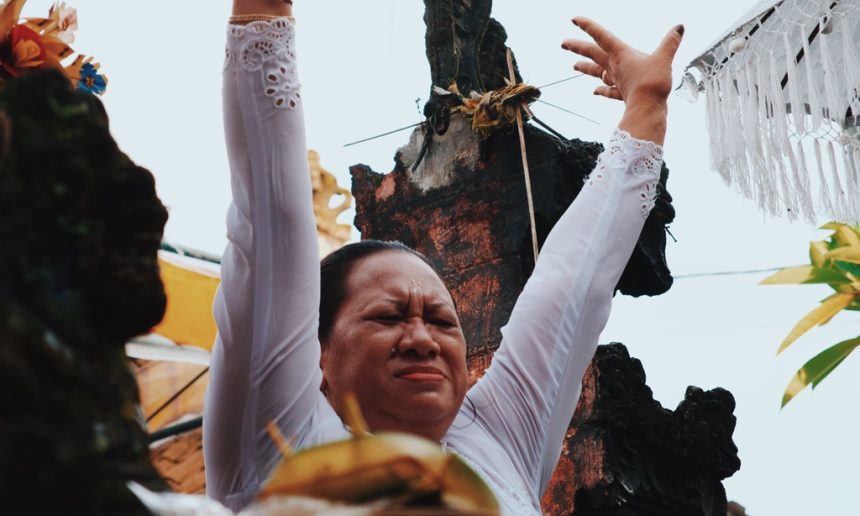
Kerauhan is understood as a moment in which sacred energy, whether that of a deity or an ancestral spirit, temporarily inhabits an individual, influencing both mind and body. Within Balinese Hindu tradition, this state is regarded as a legitimate and sacred form of spiritual communication.
Kerauhan functions as a bridge between the visible world (sekala) and the invisible realm (niskala). Through this state, guidance, protection, or warnings may be conveyed to the community, contributing to the maintenance of balance and harmony.
Those who experience kerauhan are generally individuals regarded as spiritually prepared: ritual practitioners, sacred dancers, or temple servants (pengayah) who have undergone purification rites and regularly dedicate themselves to the temple through acts of service (ngayah).
During moments of kerauhan, the altered state becomes immediately visible in the body. Muscular tone increases, movement becomes continuous, and the gaze appears fixed and inhabited, as if attention were no longer directed toward the surrounding space. Bodies sway, circle, or advance without interruption, held in a state of sustained physical engagement.
Music plays a crucial role in the emergence and regulation of trance states. The volume is intense, often overwhelming, saturating the space and immersing bodies in continuous vibration. Tempo accelerates and musical density increases, driven by rhythmic insistence and repetition. Sound accumulates, leaving little room for detachment.
Trance does not appear suddenly or independently of the music; it builds within it.
This experience is deeply collective and guided: individuals entering kerauhan are accompanied and supervised by the Pemangku, musicians, and the surrounding community, ensuring that the trance remains integrated within the ritual framework.
Credits
Article written by Hugo HELD
Mail: hugo@thelisteners
Photography: @thelisteners
Phone: +33 6 67 40 89 34